
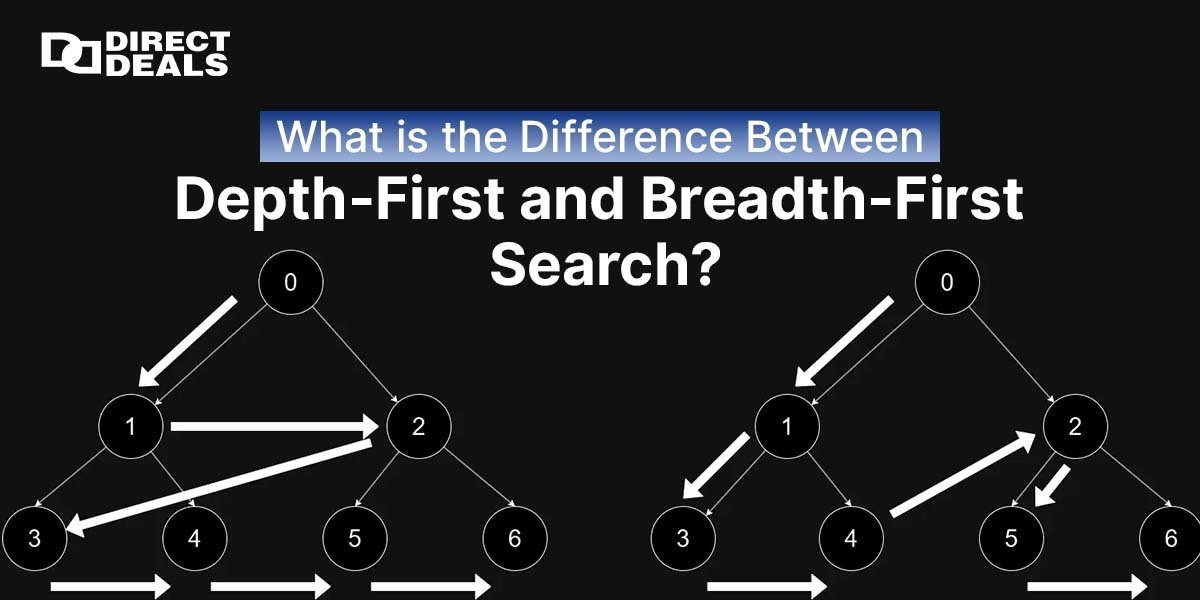
When it comes to navigating through data structures, especially trees and graphs, two of the most fundamental algorithms come into play: Depth First Search (DFS) and Breadth First Search (BFS). While both help in traversing or searching data, they work in completely different ways.
In this blog by DirectDeals a name built on 27+years of trust in technology and customer satisfaction – let’s explore these two algorithms, understand their key differences, and find out when to use which one.
What is Depth First Search (DFS)?
Depth First Search starts from a root node and explores as far as possible along each branch before backtracking. It dives deep into one path, exploring nodes as it goes, and only backtracks when it reaches a dead end.
Key characteristics of DFS:
- Uses Stack data structure (can be recursive).
- Explores a path completely before moving to the next.
- Better for problems like maze solving, puzzle games, or pathfinding where solutions are deep in the graph.
Example use case:
Imagine you're looking for a hidden file deep within nested folders. DFS is like opening each folder one by one, diving deep until you find the file.
What is Breadth First Search (BFS)?
Breadth First Search , on the other hand, starts from the root node and explores all its neighboring nodes before going to the next level of neighbors. It goes wide, layer by layer.
Key characteristics of BFS:
- Uses Queue data structure.
- Explores all nodes at the current depth before going deeper.
- Best suited for finding shortest paths, like in GPS systems or social networking connections.
Example use case:
You’re trying to find the shortest connection path between two people on LinkedIn. BFS explores all first level connections before going to second level ones.
Side by Side Comparison
| FeatureDepth First Search (DFS)Breadth-First Search (BFS) | ||
| Data Structure Used | Stack (or Recursion) | Queue |
| Approach | Depth-wise traversal | Level-wise traversal |
| Memory Consumption | Less (for wide graphs) | More |
| Finds Shortest Path | No | Yes |
| Time Complexity | O(V + E) | O(V + E) |
| Suitable For | Deep solutions, puzzles | Shortest path, level order |
Conclusion
Both DFS and BFS are essential tools in a programmer’s toolkit. If you're aiming to go deep and explore all possible paths DFS is your go to. But if you want the quickest route or need to process data level by level BFS is the better choice.
At DirectDeals, with 27+years of trust in providing reliable tech solutions and digital products, we believe understanding the core of such algorithms can empower developers, students, and professionals alike. Whether you're building software, gaming applications, or solving complex data structures, knowing when and how to use BFS or DFS can make a world of difference.
Get in Touch
Have questions or need expert guidance on your tech needs?
Phone: +1-800-983-2471
Email: sales@directdeals.com
Let’s connect and innovate together!